
InHandPlus Vibe-Watch · results
Teach a robot from your wrist.
Human-in-the-loop on a smartwatch: show a robot once, confirm with a tap, and it remembers. Here is what that did to a MicroDuck fetching a thrown tissue — measured, not staged.
InHandPlus What the watch does
Show it. It finds it. It asks when unsure.
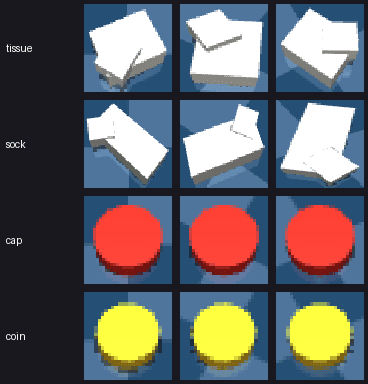 in simulation
Show it
Pick the thing up wearing Vibe-Watch. Three frames from the wrist camera become a 7 KB memory — no training, no GPU, no app to build.
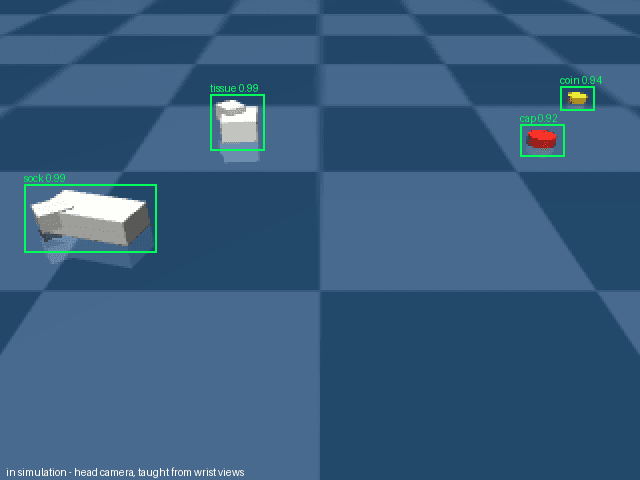 in simulation
The robot finds it
The robot's own camera matches what it sees against your memory and goes: finds it among socks, caps and coins, picks it up, carries it to the spot you showed.
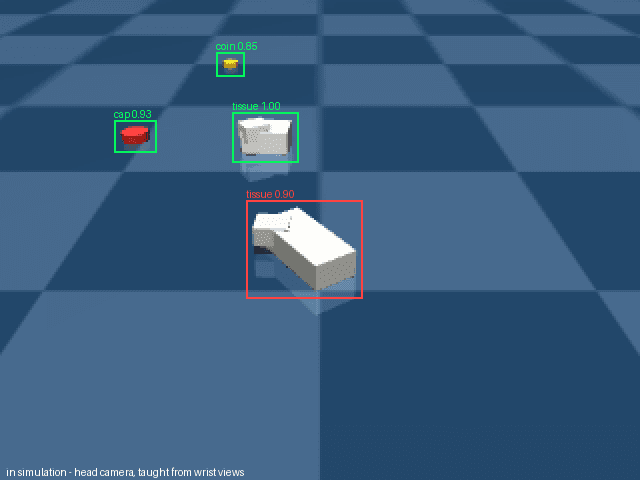 in simulation
Unsure? It asks your wrist
When two things look alike, the watch buzzes: “this one?” One tap answers. The memory updates, and it never confuses the two again.
InHandPlus Human in the loop
It asked. You answered. Done.
A sock and a tissue look alike to a small camera. Left: the robot's first guess. Right: after one tap from the wrist — on a layout it had never seen. That is the whole idea of Vibe-Watch: the person stays in the loop, one tap at a time.
InHandPlus Throw it. Say it. Done.
From your hand to the spot you showed
You throw a tissue. The duck searches, finds it among other things on the floor, walks over, picks it up, and places it on the mat you showed it once — while the watch confirms the target on the way.
30 runs, 5 landing spots · median 46s from throw to placed · memory 7 KB from 3 wrist frames
InHandPlus Why a watch
Four things only a wrist can do
Hands-free teaching
You teach by doing — picking things up, putting them where they belong. A phone can’t: if you’re holding the phone, you’re not holding the object.
No training, no GPU
Nothing is retrained. The watch writes a small memory the robot reads. Adding a new object is three frames; a new spot is one record.
Human in the loop
The robot asks when it isn’t sure, and your answer becomes part of the memory. It gets better with every tap instead of every firmware update.
Works on any robot’s built-in skills
Vibe-Watch doesn’t replace how a robot walks or grips. It tells the robot what and where — the layer no robot ships with today.
InHandPlus Get it first
After the nine presets, there is something to do.
Vibe-Watch ships as a bundle companion for MicroDuck. Waitlist members get first access to test point-to-fetch on real hardware. No payment until it's verified on the real duck.
All numbers and footage on this page were measured in simulation (MuJoCo, September 2026) with the open MicroDuck model and its shipped walking and pick policies. The watch is real hardware built by InHandPlus; real-hardware validation is planned for December. Not affiliated with Hugging Face or Pollen Robotics.